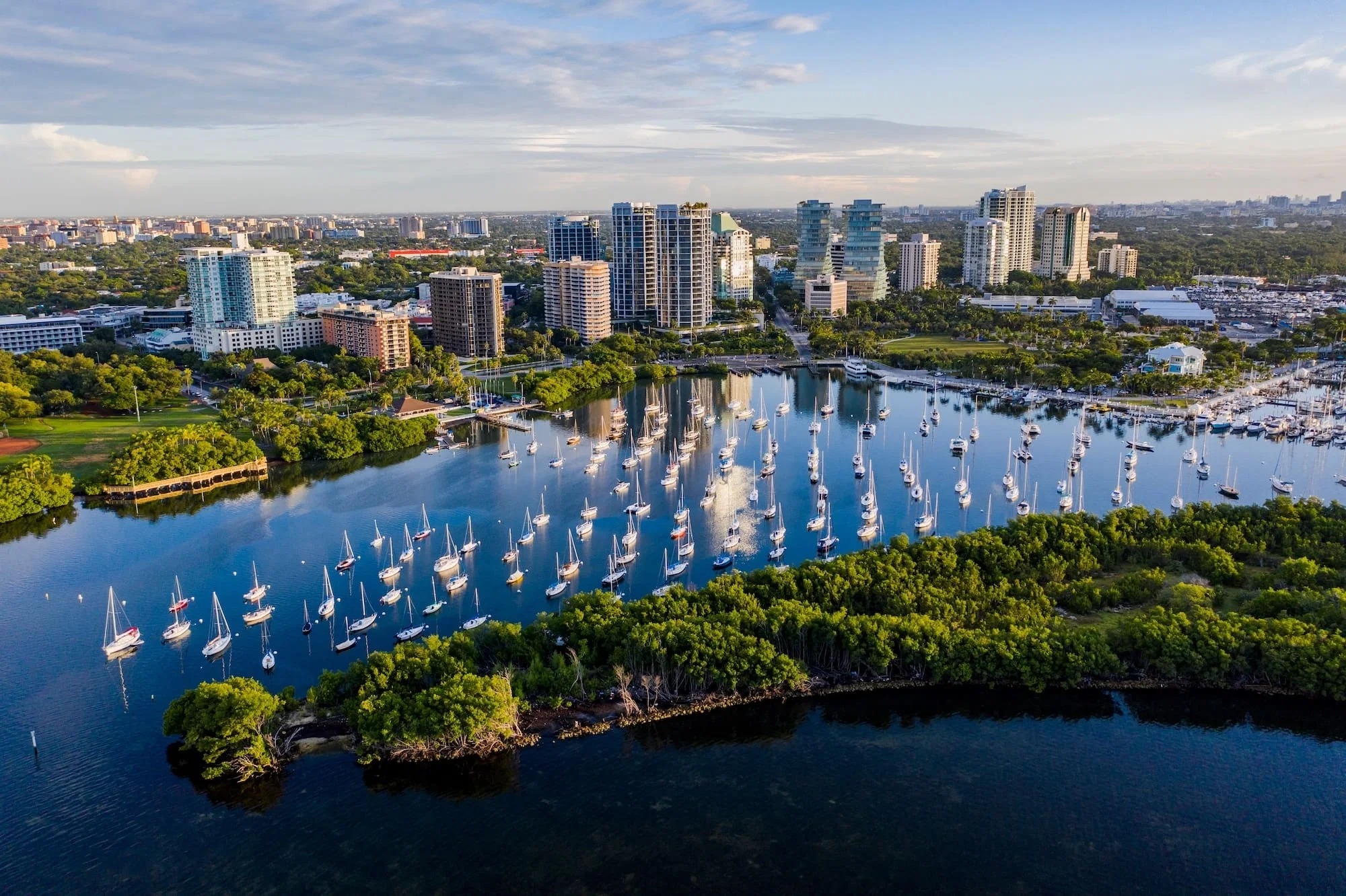
Why Coconut Grove work runs differently
Most trade show and exhibit work in greater Miami happens inside purpose-built halls with loading docks, freight elevators, and marshaling yards designed for the job. Coconut Grove has almost none of that. The neighborhood was laid out as a walkable village more than a century ago, and its commercial core along Grand Avenue and CocoWalk was never meant to absorb a fleet of box trucks on a Tuesday morning.
Staging and freight around Dinner Key
Dinner Key's marina traffic and the surrounding boatyards create a genuinely different freight environment than a downtown venue. Truck routes that work for South Bayshore Drive during a weekday morning back up fast once boat-show or marina-event traffic layers in, so we build delivery windows around those patterns rather than defaulting to a standard 8 a.m. call.
For anything beyond a small activation, freight is staged off-site, usually at a warehouse a short drive north toward US-1, then trucked to the venue in a tighter, timed sequence. That two-step approach costs a little more coordination up front and saves the client from a truck idling on a narrow residential street waiting for a dock that does not exist.
Permits in a historic district
Coconut Grove includes several designated historic zones, and construction-adjacent activity, temporary structures, and street closures near those zones move through additional review compared with a standard commercial corridor. We flag which category a given site falls into during the first scoping call so the timeline includes real permit lead time instead of an assumption borrowed from a downtown project.
Marina-adjacent sites add a second layer, since Dinner Key falls under county marine and parks oversight in addition to city permitting. Any project involving tenting, generator placement, or extended street use near the water gets those approvals sequenced early, before labor or rental commitments are locked in.
Coconut Grove routing and venue mix
Coconut Grove sits in the South Miami and Broward Spillover. Captures southern corporate and campus demand plus Broward spillover, where projects still path through the same South Florida labor, freight, and project-management ecosystem.
The venue comparison often starts with Eden Roc Miami Beach & Nobu Hotel Miami Beach, then expands into delivery timing, guest movement, and whether the district gives the crew enough room to recover from late changes.
Where the district helps or hurts the schedule
Beach corridors usually need more sensitivity around hotel guests, limited curb activity, and cross-town travel. Downtown rooms put more weight on garage access, elevator timing, and business-day traffic. Airport-west and Doral programs can simplify freight but still need clean paperwork and service-order discipline.
Coconut Grove should be chosen because it supports the event's operating needs: where freight can arrive, how quickly a supervisor can reach the room, what hotel or sponsor activity surrounds the show, and how much buffer the strike plan requires.
Planning decisions to lock early
Inline Booth Installation is the next practical question when Coconut Grove is part of the assignment because service scope determines how much labor, logistics, and floor authority the corridor needs.
Confirm the primary venue, receiving path, staging options, parking or marshaling expectations, hotel activity, and who has authority to approve field changes before the crew arrives.
- Name the building and receiving path before labor assumptions are finalized.
- Match supervisor coverage to travel time and likely change volume.
- Build strike timing around the district, not only the show close time.
Cost drivers for Coconut Grove, FL
Coconut Grove, FL pricing should be tested against the conditions that actually create cost: freight release timing, material handling exposure, labor depth, overtime risk, graphics changes, utility orders, AV testing time, and how much supervision the room needs once multiple vendors are active.
Eden Roc Miami Beach & Nobu Hotel Miami Beach can shift those costs quickly. A room with tighter access, more technical dependency, or heavier guest-facing pressure may need earlier approvals and more conservative crew planning than the same service scope would require in a simpler ballroom setup.
Stakeholder handoffs for Coconut Grove, FL
Marketing, sales, operations, procurement, venue contacts, and the show organizer usually look at coconut grove, fl from different angles. The handoff map should show what each group must approve, what can still change, and which person has authority when a field decision affects cost or timing.
Inline Booth Installation becomes useful when that handoff map needs a clear operating owner. It keeps the service scope connected to labor calls, freight handling, service orders, and final punch work instead of leaving each decision in a separate thread.
Field notes for the next South Florida date
Coconut Grove, FL should leave behind more than a finished room. Supervisor notes, freight condition, missing parts, graphics wear, labor timing, lead-capture issues, and stakeholder feedback should be captured while the show is still fresh.
Key Biscayne context matters on the next calendar too. What worked in one corridor may need a different receiving plan, schedule buffer, or staffing posture at the next venue, especially when the program moves between Miami-Dade and Broward.
- Record actual install and strike timing, not only the planned schedule.
- Document freight, graphics, AV, and service-order issues while the team can still see the cause.
- Carry venue-specific lessons into the next show brief before a new estimate is approved.
First hour on site for Coconut Grove, FL
The first hour should confirm the receiving condition, crate or rental inventory, booth footprint, utility status, graphics priority, and the communication path to the service desk. For coconut grove, fl, that early check prevents the crew from building around a missing decision.
A supervisor should also verify whether the plan still matches the room. If the aisle condition, rigging note, power drop, storage option, or sponsor requirement has changed, the adjustment needs to be made before labor is buried in work that will have to be touched twice.
Approval trail and closeout discipline
Coconut Grove, FL works better when approvals are visible: final artwork, structural assumptions, outbound labels, rental return condition, AV ownership, service desk notes, and any client changes that affect cost. The paper trail protects the opening and the post-show conversation.
Closeout should produce a cleaner next estimate. The team should know which materials traveled well, which timing assumptions were wrong, which venue requirements created friction, and whether the same service scope should be repeated, simplified, or upgraded for the next South Florida date.